Key facts
| Sector | Art, apparel and collectable fashion |
|---|---|
| Type | E-commerce store on WordPress and WooCommerce, custom theme |
| Market | London, shipping worldwide |
| Built with | WordPress, WooCommerce, a custom child theme, custom must-use plugins, a print-on-demand integration |
| What ruxox delivered | Redesign, theme build, catalogue and category structure, product copy, sell-your-art submissions and review emails, artist pages, staging and deploy pipeline |
| Status | Live store; the redesign launches in late 2026 |
The brief
The first version of notpublic.studio was a standard WooCommerce shop on a bought theme: a handful of canvas prints and tees in a product grid, a newsletter pop-up and a cookie bar. It worked, but it looked like thousands of other shops, and it had no room for what the studio wanted to become: a place for original art by other artists and for rare pieces that exist once.
The brief was a store that feels like a gallery and an auction catalogue rather than a template, that can take in work from outside artists without turning the owner into a full-time administrator, and that keeps everything the existing shop already did, from orders and customers to payments and made-to-order production.
What we built
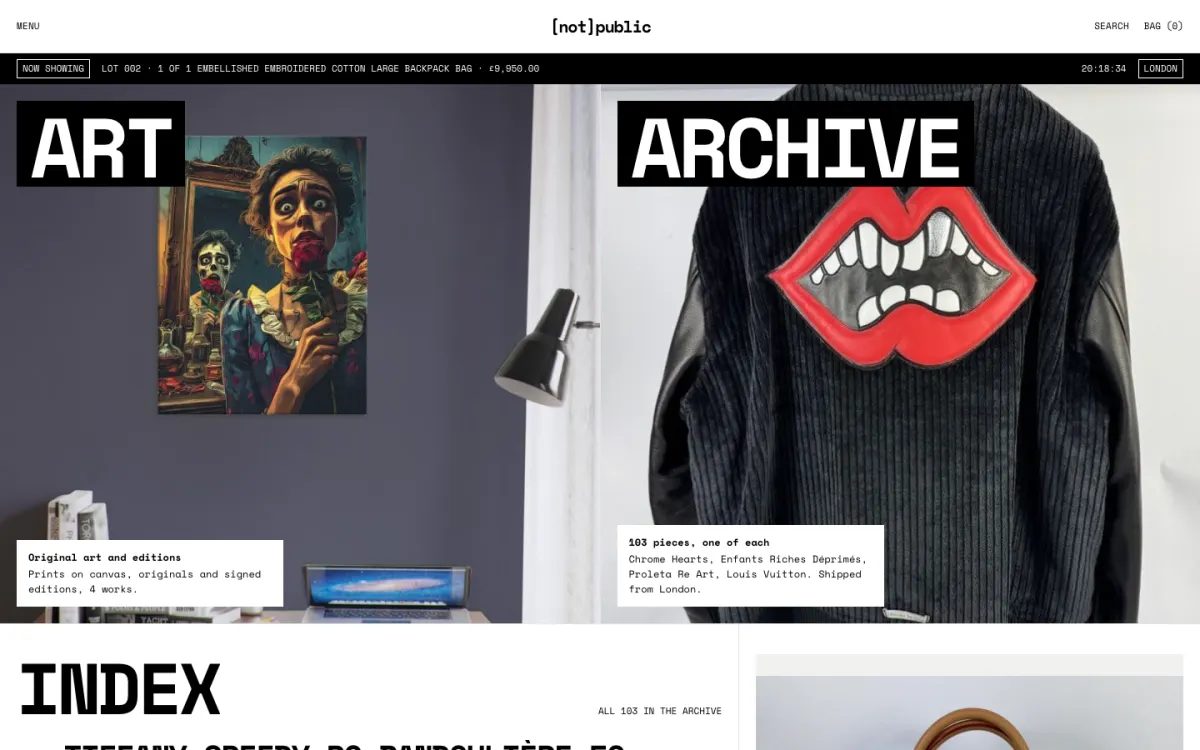
- A new identity in the theme. A monospace, black-and-white design with a “Now showing” ticker, a London clock and every product numbered as a lot. The homepage splits into two doors, Art and Archive, before anything else.
- An index, not just a grid. The shop can be browsed as photos or as a numbered index, filtered by section, designer, type, condition and price, with an “available only” switch so sold pieces stay visible as a record without getting in the way.
- Art. Original works and signed, numbered limited editions, each sold with a signed certificate of authenticity, alongside prints on canvas and apparel made to order by a print partner, so nothing is held in stock.
- Archive. One-of-a-kind designer and wearable-art pieces, each with its condition and size stated plainly and shipped from London. The highest-value pieces use a request-this-piece enquiry instead of an instant checkout.
- Sell your art. Artists send one piece at a time, with details and 3 to 8 photos, through a form that needs no account. Each submission becomes a draft product for review, and the artist is emailed whether it is accepted or declined. Accepted work goes live on the artist’s own page with their bio and links. The work stays with the artist until it sells, and they ship it straight to the buyer.
- Plain pages. Rewritten product copy, size guides, shipping and returns, FAQs and a contact page, with search titles and descriptions for every page that should be found and noindex on the ones that should not.
How it is built
WooCommerce, kept where it is strong. Orders, customers, payments, tax and stock already lived in WooCommerce, so moving platform would have cost the studio money and risk for no gain. The redesign is a child theme on top of the existing parent theme, so the switch is one command and so is the undo.
Custom logic in small plugins. The submission form, the review workflow, the artist pages and the emails are must-use plugins kept in Git, not a stack of paid extensions. Spam protection is built into the form, and a submission can be judged from the email without logging in.
A safe way to change a live shop. A full copy of the store runs locally with outgoing email and payment calls blocked, so the redesign could be built and tested against real products without touching customers. A deploy pipeline uploads only the theme and the custom plugins, never the database, and a written go-live checklist covers backups, the switch, checks on a phone and the undo.
Made-to-order stays automatic. Prints on canvas sync from the print partner into WooCommerce, and the content changes are applied by a script that saves every original first, so a product update from the partner can be re-applied rather than lost.
What this shows
A WooCommerce store does not have to look or behave like a WooCommerce store. When the business already runs on WordPress, the best result usually comes from keeping the platform and rebuilding what visitors see and what the owner has to do by hand: here, a gallery-style front end and a submission flow that turns an artist’s email into a reviewed, ready-to-publish listing.
It is the WordPress counterpart to GEMLUX, which we built on Shopify. Both sell one-off, high-value pieces; the platform was chosen to fit the business, not the other way round.
Where this fits
This is a WooCommerce development project: a custom theme, custom plugins and a catalogue restructure on an existing store. If you are deciding between platforms, see our Shopify development page too. Every engagement starts with a written scope that names the riskiest part of the build and a fixed price agreed before work starts. See straightforward pricing, or send us a brief for a free estimate within 48 hours.