What we build on Shopify
Shopify already does checkout, payments, tax, inventory and shipping well, so we do not rebuild them. Our work goes where a store is won or lost: how it looks, how fast it loads, how the catalogue is organised and what happens beyond the basket.
- Custom themes from scratch. Designed for your brand and written in Liquid on Online Store 2.0, with JSON templates and sections on every page, not a Theme Store theme with a new logo.
- International stores. Several languages at their own URLs with hreflang tags, right-to-left layouts for Arabic, and local currencies through Shopify Markets.
- Catalogue structure. Collections, filters and navigation organised the way your buyers search, so every designer, category or range has a page that can rank.
- Custom sections and product data. Metafields and metaobjects for details such as materials, sizing, grading or care, edited once and shown wherever they belong.
- Flows a theme does not include. Consignment and trade-in intake, appointment booking, wholesale enquiry forms and quote requests that land in your inbox with the details you need.
- Migrations. Moving from WooCommerce, Magento, Wix or Squarespace with products, customers and order history carried over and every old URL redirected.
- Speed and SEO fixes on an existing theme: removing app bloat, right-sized images, clean structured data for products and breadcrumbs.
Custom theme or a Theme Store theme?
A bought theme is the right answer for many new stores, and we will tell you if yours is one of them. A custom theme earns its cost when the brand, the catalogue or the market does not fit a template.
| Theme Store theme | Custom theme | |
|---|---|---|
| Upfront cost | Free to a few hundred pounds, plus set-up | £5,000–£15,000 + VAT for a single-market store; from £15,000 for an international one |
| Look | Shared with thousands of other stores | Designed for your brand and products |
| Speed | Carries code for features you do not use | Only the code your store needs |
| Languages and RTL | Often breaks in right-to-left layouts | Built and tested in every language you sell in |
| Special flows | Added with paid apps, one per feature | Built into the theme where it makes sense |
| Best for | New stores proving demand | Established brands, premium goods, international sales |
If you are unsure, our build vs buy decision tool and our guide to bespoke vs off-the-shelf software walk through the same reasoning we use in a scope.
How we build a custom theme
Editable by design. Every template is made of sections and blocks, so your team can rearrange a homepage, launch a campaign page or change a collection banner in the theme editor. We set sensible limits so an edit cannot break the layout.
Fast by default. We keep JavaScript to what the page needs, serve images at the right size through Shopify’s image CDN, lazy-load below the fold and avoid apps that inject scripts on every page. We test on a mid-range phone on a mobile connection, not only on a fast laptop.
Built for search. Clean headings, product and breadcrumb structured data, canonical URLs, alt text from your product data, and hreflang for each language, so search engines show each buyer the right store.
Safe to change. Work happens on a development theme on your store, tracked in Git, and you review it on the real store with your real products before anything is published. Launch is switching the live theme, so there is no downtime.
Shopify work we have shipped
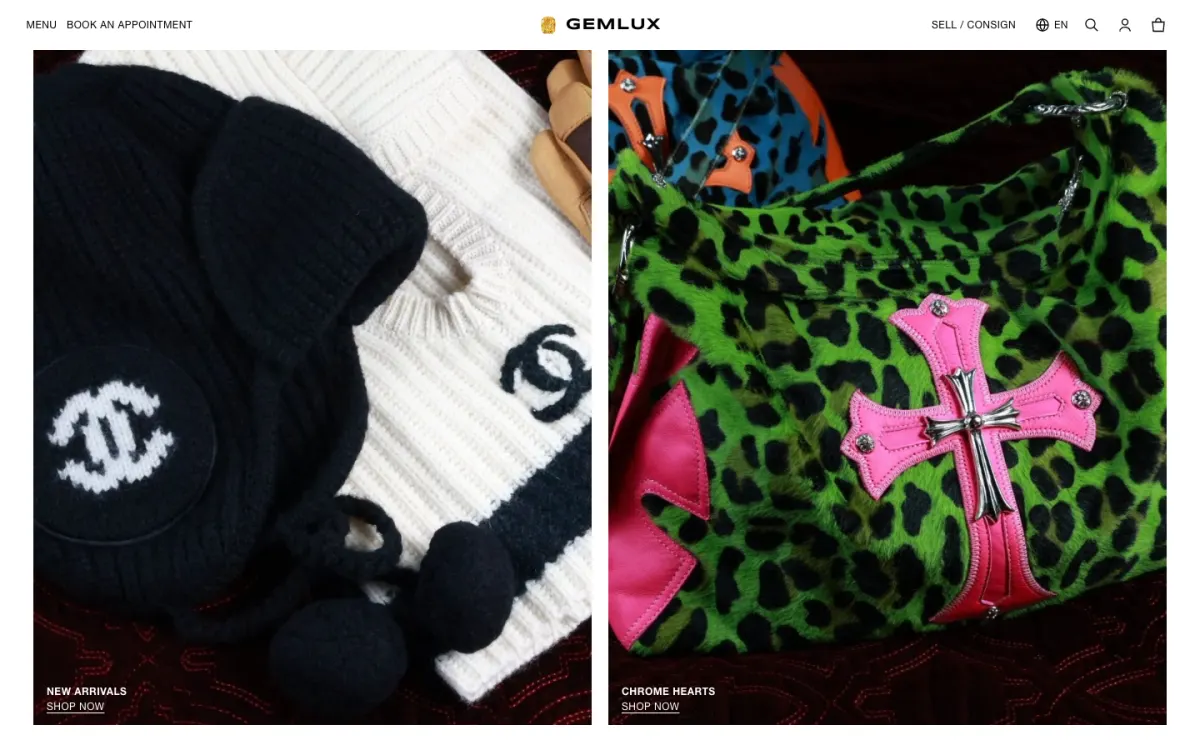
GEMLUX is a London reseller of authenticated designer pieces and fine jewellery. We built its store on a custom Shopify theme with more than 1,200 product pages across around 170 collections, in English, Japanese and right-to-left Arabic, with prices in the buyer’s own currency. The theme carries the parts a template would not: a written authenticity guarantee, diamond grading and appraisal pages, appointment booking and a four-step sell-and-consign flow that brings new stock in. Read the GEMLUX case study for how it is built.
Process and timeline
- Within 48 hours of your brief: a written scope listing the templates, languages, integrations and migrations, what is excluded, and a fixed price.
- Weeks 1–2: design of the homepage, collection and product templates using your real products, agreed before build starts.
- Weeks 2–5: theme build on a development copy of your store; you review each template as it is finished.
- Weeks 5–8 (if scoped): languages and currencies, migration and redirects, testing on real devices, launch and a handover session.
You pay a 50% deposit when work starts and the balance against milestones you have seen running, as described on our pricing page.
Shopify pricing
| Job | Price (+ VAT) | Typical time |
|---|---|---|
| Custom sections, theme refresh or speed fixes | from £3,000 | 2–4 weeks |
| Custom theme for a single-market store | £5,000–£15,000 | 4–8 weeks |
| International store (several languages or currencies), migration, several integrations or a custom app | from £15,000 | 8+ weeks |
These are our standard MVP Sprint, Product Build and Platform Build bands. Shopify’s own plan, payment fees and any paid apps are billed by Shopify and the app makers, not by us. An optional care plan from £150 a month covers theme updates and fixes after launch.
When Shopify is not the answer
Shopify is built for selling products through a basket. If what you sell is quoted, booked or arranged in conversation, a store is the wrong shape. A private jet charter or a luxury concierge needs a price range and a person, not a checkout, which is why we built RoutePass and OF.luxury as custom software instead. We will recommend whichever fits, and the scope explains why.