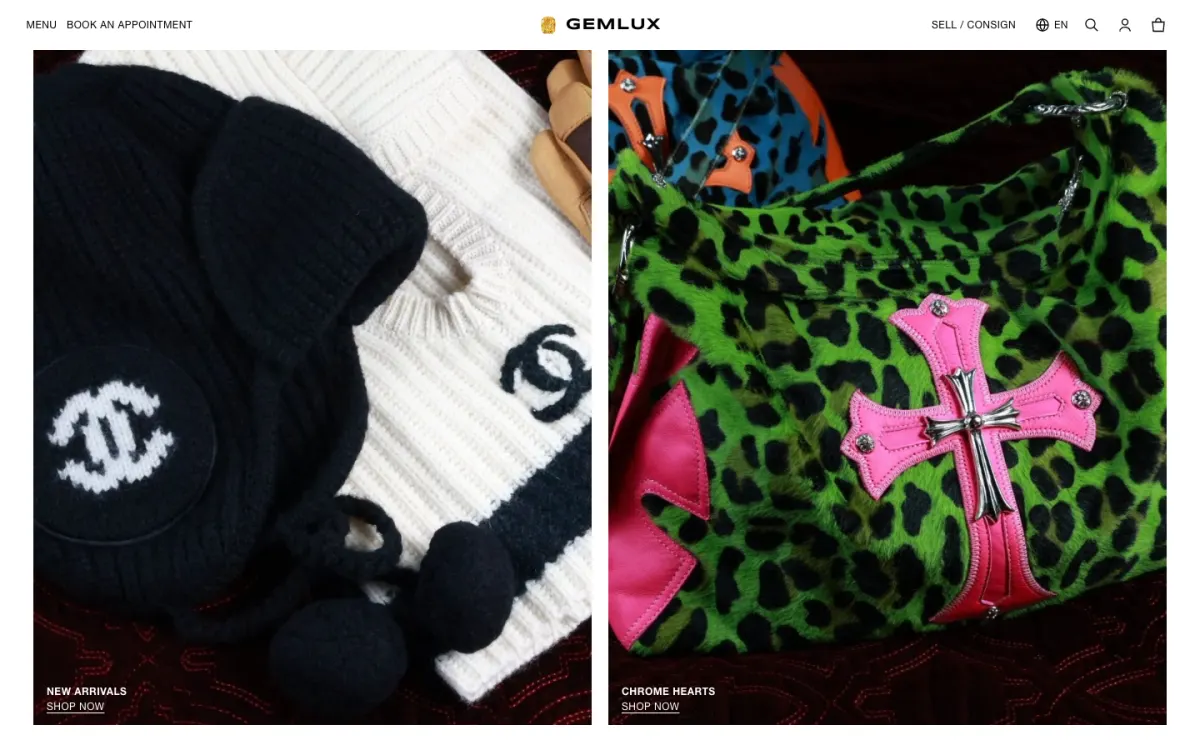
Key facts
| Sector | Luxury resale and fine jewellery |
|---|---|
| Type | E-commerce store on Shopify, custom theme |
| Market | London, shipping worldwide |
| Built with | Shopify, a custom-built theme, Shopify languages and local currencies |
| What ruxox delivered | Theme design and build, catalogue structure, three-language set-up, authenticity, consignment and appointment pages |
| Status | Live in production |
The brief
Luxury resale sells on trust. Someone paying £15,000 for a pair of vintage Chrome Hearts jeans, or £14,950 for a Louis Vuitton Speedy, needs to believe the piece is real, see the exact item they will receive, and know what happens if it turns out not to be. A store that looks like a marketplace listing loses that sale before the buyer reads a word.
GEMLUX also had two problems a standard store does not solve. Its buyers are international, so the store had to work properly in Japanese and in right-to-left Arabic, not through a translate button. And its stock comes from people selling their own pieces, so the site had to buy as well as sell.
What we built
- A deep catalogue. At the time of writing the store has more than 1,200 product pages across around 170 collections: designers from Chrome Hearts, Louis Vuitton and Chanel to Enfants Riches Déprimés, departments for men, women, accessories and footwear, and curated edits such as Vintage, Art & Objects, Staff Picks and Entry Pieces. Sold pieces move to a Sold Archive rather than disappearing.
- Product pages that show the real item. Every listing is photographed as it is, with any signs of wear, so the page is a description of one object rather than a model.
- Three languages and local currencies. English, Japanese and Arabic each have their own URLs, the Arabic store mirrors to right-to-left, and a country selector shows prices in the buyer’s own currency.
- Trust pages written as policy. An authenticity guarantee (every piece inspected by hand in London; a full refund including delivery, with no time limit, if an item is shown not to be authentic), plus diamond grading, appraisals, a size guide, FAQs and a clear statement that GEMLUX is an independent reseller, not affiliated with the brands it sells.
- Sell and consign. A four-step intake: send a request, receive an outright offer or consignment terms in writing, drop the piece off in London or send it insured by DHL, and get paid by bank transfer. The form includes a photo guide listing the six views the team needs, with at least four photos per piece, so a submission can be judged without a long back-and-forth.
- Appointments and a journal. Clients can book a private viewing, read the journal, and join a newsletter that gives 5% off a first order.
How it is built
Shopify for the commerce, custom work for the brand. Checkout, payments, inventory, tax and shipping are problems Shopify has already solved well, so rebuilding them would have cost the client money and added risk. The custom work went where it shows: a theme designed and built for GEMLUX rather than bought from the Theme Store, with large photography, a quiet layout and the product as the only loud thing on the page.
Languages done properly. Each language lives at its own address, with hreflang tags so search engines show Japanese buyers the Japanese store and Gulf buyers the Arabic one. The theme handles right-to-left layout for Arabic, which a theme built only for left-to-right reading breaks in dozens of small ways, from carousels to price alignment.
Catalogue structure as merchandising. Collections are organised the way buyers in this market search: by designer first, then by department and by edit. That gives every designer a page of its own that can rank, and lets the team feature a drop or a single collector’s pieces without reorganising the store.
Stock in, not just stock out. The consignment flow is the part a template does not give you. It turns a vague “sell with us” email into a structured request with designer, item, size, condition and photos, so the team can price a piece from the submission instead of starting a long conversation.
What this shows
Not every build should be custom software. When the business is a shop, the right answer is usually a mature platform with custom work on top, and that is what we recommend when it fits. Our guide to custom software versus off-the-shelf explains how we make that call, and the build vs buy tool gives you a first view for your own project.
The custom work still matters. Trust copy, a catalogue structure that matches how buyers search, international set-up and an intake flow for new stock are what make a luxury store sell, and none of them come in the box.
Where this fits
This is a Shopify development project: an e-commerce build on Shopify with a custom theme, scoped and priced like every ruxox engagement: a written scope, the riskiest part named honestly and a fixed price agreed before work starts. See straightforward pricing for the tiers, or send us a brief for a free estimate within 48 hours.